
RESEARCH UPDATE – STOPS.PHYSIO
Advance Healthcare has always chosen assessment and treatment methods driven by the latest robust evidence from research literature. For people with chronic pain, the evidence clearly shows that identifying patient-centred goals and developing an aggregated activity and exercise program that progressively leads them to these goals is the most effective approach. The key focus of the Advance Healthcare and Latrobe University research team has been individualising treatment within the graded activity and exercise program to target specific components that further increase effectiveness. One example is that different types of programs are required for people with a significant physical injury (nociceptive or neuropathic pain) compared to people where the pain is mostly due to increased pain sensitivity within the nervous system/spinal cord (nociplastic pain).
Rather than just review and implement the evidence-based literature, Advance Healthcare has conducted their own research over the last 20 years which has resulted in over 80 peer-reviewed publications. The STOPS randomised control trial published in 2016 was our first major clinical trial achievement. The trial demonstrated that individualised physiotherapy is more effective than guideline-based treatment, and its recommendations continue to inform our pain management program.
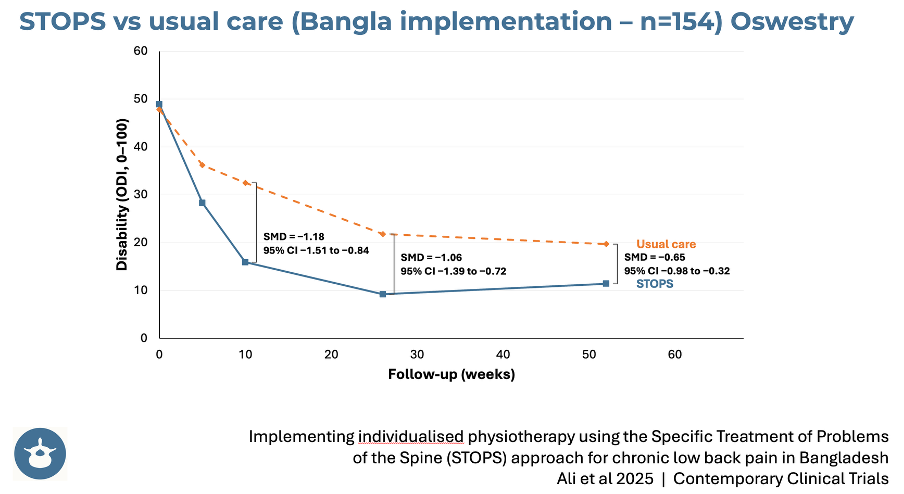
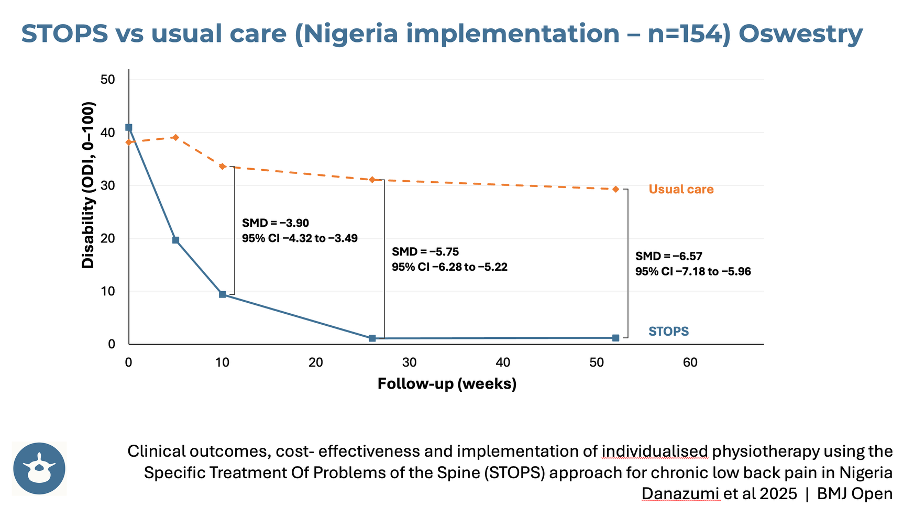
Excitingly, we have recently completed three further major clinical trials in India, Bangladesh, and Nigeria. Our Managing Director, Jon Ford, has presented these trials to the World LBP Congress in November 2026 (see https://youtu.be/g2e6E9HhqGs to watch the presentation). With improvements in the clinical protocol, these trials have resulted in major and clinically significant improvements in the STOPS group compared to usual care physiotherapy. In many cases, patients have achieved a full recovery. The results of the trial can be seen in the graphs below. The blue line represents the STOPS group and the other line represents usual care physiotherapy group. The results show that the patient’s disability in the Nigeria trial essentially resolved and dramatically improved in the other trials compared to only partial improvement in the usual care group.
We aim to publish these clinical trials in the coming months. And hopefully the results will have a major impact on evidence-based treatment of low back pain worldwide. For those interested in being sent these papers once published, or wish to receive further information about our clinical research program, please contact jford@advancehealthcare.com.au.